Showing posts with label Supercars. Show all posts

2010 Venom GT Hennessey Supercar Concept

Hennessey Performance Engineering today announced that it is introducing the company's first concept car - The Venom GT. Penned by British auto designer, Steve Everitt, the Venom GT would incorporate Hennessey's potent Venom 1000 Twin Turbo Viper V10 powerplant into a light weight mid-engine chassis weighing "under 2,700 lbs". Power would be run through a 6-speed transmission or optional sequential gearbox. With a power to weight ratio of just 2.7 lbs per bhp Hennessey estimates that the Venom GT could attain 0 to 100 km/h times in less than 2.5 sec. and a 0-300 km/h time of around 14 seconds.
Venom GT Hennessey Supercar
The Hennessey Venom GT weights less than 2,400 lbs (1,071 Kg) and to stop the Venom GT, Hennessey added Brembo brakes with 6-piston calipers up front and 4-piston calipers in rear clamping down on 15-inch carbon ceramic rotors. Hennessey plans on building 10 units of the Venom GT annually and four have already been sold at around $600,000 a pop. That means there are only six units left from the first allocation.
Venom GT Hennessey Supercar
SEALY, TEXAS & SILVERSTONE, ENGLAND, March 29, 2010 - Hennessey Performance is pleased to introduce the first official images of its Venom GT supercar. Based upon the Lotus Elise, the Venom GT combines a high-tech, lightweight British chassis with a powerful American V8.
Venom GT Hennessey Supercar
“This is not the first time that Britain and America have joined forces to produce a weapon of mass propulsion”, said company founder and president, John Hennessey. “Over fifty years ago the American-built P-51 Mustang fighter aircraft was flown into history powered by a British Rolls-Royce Merlin engine. Today the Hennessey Venom GT promises to set a new standard of power to weight ratio in the rarefied air of today's supercar market.”
Venom GT Hennessey Supercar
In the case of the Venom GT, less weight means more performance. The Venom GT will have a production curb weight of less than 2,400 lbs (1,071 kilos) aided by its lightweight carbon fiber bodywork and carbon fiber wheels. Stopping power is delivered via Brembo brakes with 6-piston calipers up front and 4-piston calipers in rear clamping down on 15-inch carbon ceramic rotors.
Venom GT Hennessey Supercar
The Venom GT’s base power plant is the supercharged 6.2 liter LS9 V8 (the same as in the Corvette ZR1) tweaked by Hennessey to 725 bhp. The company will also be offering 1000 bhp and 1200 bhp twin turbo V8 engine variants. The mid-engine V8 will transmit its power to the rear tires via a Ricardo 6-speed gearbox.
Venom GT Hennessey Supercar
Hennessey plans to manage power output by using a programmable traction control system. CFD (computational fluid dynamic) tested bodywork and down force will also help keep the Venom stable at speed. An active aero system with adjustable rear wing will deploy under varying conditions on both the road and racetrack. An adjustable suspension system will allow ride height adjustments according to speed and driving conditions. Finally, power will be put to the ground via massive Michelin PS2 tires.
Venom GT Hennessey Supercar
Hennessey will be building the power plants at its Texas facility. The engines will then be air freighted to the company's assembly facility near Silverstone, England where the Venom GT is built and tested. Venom GT buyer will be offered a 1-day driver orientation and instruction program by a Hennessey factory test driver, at a track in the UK or USA prior to delivery.
Venom GT Hennessey Supercar
Hennessey plans on building 10 units of the Venom GT annually and four have already been sold at around $600,000 a pop. That means there are only six units left from the first allocation. The company plans to establish a network of Venom GT dealers and distributors in the Middle East, Europe, Russia, Australia and Asia.
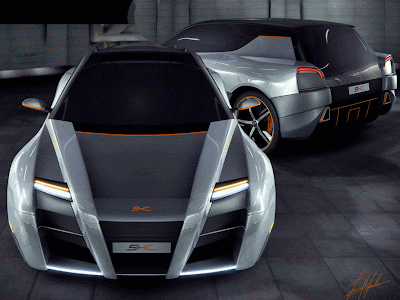
2010 Super Hatchback Concept Car by Jamie Martin

Details on a possible future eco-friendly model, called SHC (Super Hatchback Concept), were revealed by designer Jamie Martin, a UK based designer whose previous works include the Cobra Venom V8 concept and the London Navigator bus. The SHC was conceived out of a desire to fuse the two very different worlds of hatchbacks and supercars. And in a world where limiting CO2 output is becoming increasingly important, the SHC also has some green tech up its sleeve.
2010 Super Hatchback Concept Car by Jamie Martin 
Designed to compete against the likes of the Honda Civic Type-R and Ford Focus RS, the SHC would be offered with a choice of two different engine/transmission packages.
It has similarities to both a supercar and a 3-door hatchback and boasts of both styling and performance characteristics. The concept car is available in a choice of three next generation powertrains, including an electric / hybrid option. Interestingly, the body is composed of 65% Steel and 35% aluminum used for front wings, bonnet & bumpers. Alternatively, 30% glass reinforced plastic can be used for designated sections. 
2010 Super Hatchback Concept Car by Jamie Martin 
Other features include front and rear window ‘air-streams’, combined with hydrophobic and super-fast screen heating and high-intensity LED/Single-Source fiber-optic illumination used on the headlight wing, lower fog light, and rear lights. Martin describes the car to have a “balanced formula of raw power, racing spirit, practicality and eco engine choices.” He said that this means that you have a supercar-inspired drive to use for weekly shopping.
2010 Super Hatchback Concept Car by Jamie Martin 
The first proposed powertrain of the concept consists of a twin-turbocharged internal combustion engine with direct injection, stop-start technology and regenerative braking. Transmission would be via a 6-Speed Short-Shift manual gearbox or a 7-speed paddleshift auto.
2010 Super Hatchback Concept Car by Jamie Martin 
The second option is a system dubbed the 'Delta Drive Hybrid (DDH)'. This setup consists of a smaller displacement internal combustion engine and a pair of electric motors. Nano-Titanate batteries located in the engine bay, and under the floor would feed power to the high-torque electric motors mounted within the front wheels. 3-performance modes would be available: Economy (low bhp town driving), Normal (medium bhp - motorway driving), and Performance (high bhp - utilising both the petrol engine and electric generator together for ultimate power). The car could also be driven in full electric mode for around 70 miles before the engine was needed to recharge the batteries.
2010 Super Hatchback Concept Car by Jamie Martin 
Further highlights of the SHC include a magnetorheological fluid suspension system with Normal, Sport & Track modes. This system, first used by Ferrari, features dampers with iron filings suspended in fluid. When an electrical current is passed through the fluid it instantaneously changes the damping rate and stiffens up the suspension.
2010 Super Hatchback Concept Car by Jamie Martin 
While the SHC is just an independent concept with no intention of production, it does seem more and more likely that hybrid technology will filter very quickly into performance vehicles - and hot hatches could be one of the first segments to make the switch.

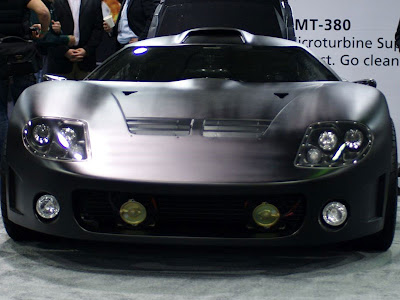
Capstone Supercar CMT-380 the high performance hybrid electric microturbine vehicle Debut at LA Auto Show

Capstone Supercar CMT-380

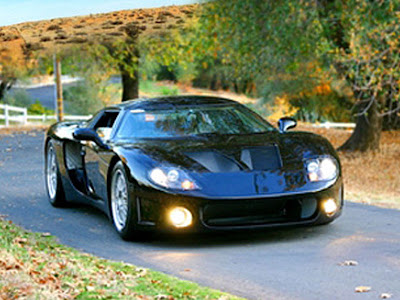
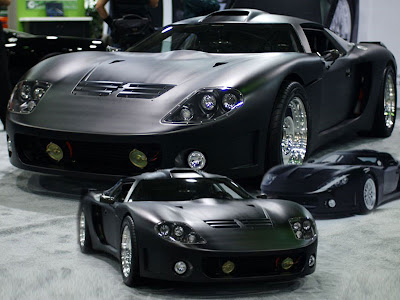
The Capstone CMT-380 was the surprise basement find of the LA Auto Show.The Capstone CMT-380 is essentially a prototype show car designed to highlight the technology and products available from Capstone Turbine Corporation. The concept for the high performance hybrid electric microturbine vehicle was developed by Electronic Arts (EA) Chief Creative Director Richard Hilleman.
Capstone Supercar CMT-380

After working on the car for four years, inventor Richard Hilleman was the man of the hour as he fielded questions about his unusual microturbine-lithium-ion hybrid powertrain fitted to a GTM Supercar kit body. It may still be in the test phase, but Capstone claims that the car can reach a top speed of 150mph, and is able to sprint from zero to 60mph in just 3.9 seconds.
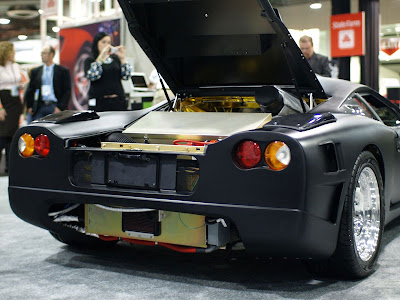
The CMT-380 features an unusual hybrid drivetrain which uses one of Capstone's new C30 (30-kilowatt) microturbine engines to extend the range of the primarily electric powered vehicle. The turbine can be run on either diesel or biodiesel.
Capstone Supercar CMT-380

The CMT-380 features lithium-polymer battery cells that can be charged at home or at a public recharging station. While driving, the CMT-380 can operate on 100 percent battery power in zero emissions mode for a range of up to 80 miles. When the batteries reach a predetermined state of discharge, the Capstone C30 microturbine quietly fires up and recharges the batteries on the fly to extend the driving range up to 500 miles. The diesel fueled C30 microturbine requires less maintenance than traditional combustion engines and produces ultra-low exhaust emissions. Hilleman has owned an electric vehicle – a converted Porsche 550 Spyder – for at 15 years and has constantly upgraded it. The EV used to have just 30 hp with lead acids but now uses lithium ferrous batteries and has 200 hp. The 100-mile range hasn't changed, though, and so he knew it was time to build a hybrid. He decided on Capstone's diesel microturbines as the range extender.
Capstone Supercar CMT-380

He knew he could rely on them – they've been used in buses for years – but there was still the challenge of fitting the unit into a car like this. Hilleman built the CMT-380 just for himself, but Capstone is happy to show it off as a proof of concept vehicle. It would be too pricey to put into mass production (Hilleman estimated he put in about $375,000 hours of work), but it's not impossible that a high-end, expensive, limited production run could be made some day.
Capstone Supercar CMT-380

Right now, Hilleman is really happy with his creation. He especially loves the sound of the vehicle. Three feet to the side of the car, the microturbine puts out about 87 dB, but in the cabin, it's nearly silent. California law might require him to add a muffler, but it's already quiet enough without one. He's got a solution for that problem, should he need it.
The chassis and bodywork of the Capstone CMT-380 are borrowed from the Factory Five GTM kit sports car, and modified to accept the hybrid drivetrain.
Capstone Supercar CMT-380

"Capstone's CMT-380 is just now finishing up the conceptual design and first article testing stage," said Darren Jamison, Capstone President and CEO. "We plan to finalize very soon a limited production plan, in part, based on interest received at the [2009] LA Auto Show. We anticipate customers will be a select group of individuals who appreciate its many innovative high-performance and high-technology driving characteristics, long driving range and ultra-low emissions," added Jamison.

The De Macross GT1, Canada's Supercar The Exotic Sports Cars

The De Macross GT1, Canada's Supercar The Exotic Sports Cars
The newest and the only super car from Canada is heading fast towards its production line. Beauty in the eye of......Canadians. This is a completely homespun supercar that we can be proud of. Early indications point to a vehicle that will be every bit a match for the world's best Super Sport Cars. It is an attempt to disturb the calm of minds of the big three and smaller sports car manufacturers present in North America and abroad.
The De Macross GT1, Canada's Supercar The Exotic Sports Cars
Jahong Hur who has founded the company has put his caliber in the designing of the newly developed super car. In the process of doing so, he proved that if someone wants something badly enough, it is always possible to realize that. Thanks to a wealthy Korean businessman, Canada's Multimatic Inc. is now in the business of building exotic sports cars.
The De Macross GT1, Canada's Supercar The Exotic Sports Cars
Mr Johang Hur loves cars and wanted transportation evocative of the Le Mans cars of the '60s but suitable for street driving. For the creation he went to Ontario's Multimatic, responsible for no less than building the Mustang Boss 302R for Ford Racing and the Canadian homologation of the Ford GT. They also build the carbon-fiber monocoque passenger cell for the Aston Martin One-77.
The De Macross GT1, Canada's Supercar The Exotic Sports Cars
Canada is not exactly a mecca for exotic car creation. We're known more for our Corollas than Europe's Paganis, Bugattis and Koenigseggs. That is, until recently: First came Quebec's Pléthore LC-750 and now, almost out of the blue, the De Macross GT1, the first super sports car from upstart, Vancouver-based automaker De Macross Motors Corporation (DMMC).
The De Macross GT1, Canada's Supercar The Exotic Sports Cars
Working closely with Multimatic Engineering, a motorsports engineering firm that has worked with the likes of Shelby Automotive and Aston Martin in the past, The De Macross GT1, Canada's Supercar The Exotic Sports Cars has created a new mid-engine supercar platform composed of an aluminum monocoque tub structure, with integrated front and rear sub-frame modules for suspension, steering, engine and driveline mounting.
The De Macross GT1, Canada's Supercar The Exotic Sports Cars
Multimatic is a Canadian company supplying components, systems and services to the global auto industry. With its headquarters located in Markham, Ontario, it operates several divisions in North America, Europe and Asia, and has manufacturing ties in South America and Australia.
The De Macross GT1, Canada's Supercar The Exotic Sports Cars
Its core activities lie in the manufacture of stampings, welded assemblies, mechanisms, and suspension components. It is also involved in the design and development of automotive body and chassis systems.
The De Macross GT1, Canada's Supercar The Exotic Sports Cars
The platform also combines plenty of carbon fiber and has been structurally optimized to provide a stiff and stable platform at the lowest possible weight, while meeting global safety standards. Installed within this structure is an independently adjustable push-rod suspension system similar to that used in F1. There is also a hydraulic anti-roll device similar to that used by the new McLaren MP4-12C supercar.
The De Macross GT1, Canada's Supercar The Exotic Sports Cars
Unveiled to the world early this year at the Multimatic headquarters outside of Toronto, the GT1 is no fly-by-night prototype, but a production-ready machine that hits all of the high notes expected of a hand-built, rear-drive super car: aluminum and carbon-fibre construction, power The De Macross GT1, Canada's Supercar The Exotic Sports Cars comes from the aforementioned Roush 5.4-liter V8 connected to a six-speed manual, a top-speed near 350 km/h and of course, a million-dollar price tag. The goal is to produce more than 800 hp and 700 lb-ft of torque, enough they think to propel The De Macross GT1, Canada's Supercar The Exotic Sports Cars to 62 mph in approximately 3.5 seconds.
The De Macross GT1, Canada's Supercar The Exotic Sports Cars
The Multimatic team is heading to Florida in March to begin fine-tuning the car's dynamics on-track, but will return to the True North, Strong and Free once the snow disappears. The company has a long-term relationship with Calabogie Motorsports Park west of Ottawa as a location for homegrown vehicle development work.
The De Macross GT1, Canada's Supercar The Exotic Sports Cars will likely begin sales of the GT1 towards the middle of this year through what Wang describes as a "one-on-one type of sales and delivery process you'd expect from this caliber of car." The on-sale date will coincide with a world tour to introduce the globe to Canada's newest super car.

2011 Jaguar Sport Cars E-Type Speedster

 2011 Jaguar Sport Cars E-Type Speedster
2011 Jaguar Sport Cars E-Type Speedster – Eagle, the exclusive Eagle E-Type car makers, upgraded with further muscular styling, more fresh classic details, completed with the contemporary supercar performance.
2011 Jaguar Sport Cars E-Type Speedster
It is inspired by one of the most iconic sports cars and most handsome of all time UK: Jaguar E-Type sensual from the sixties. Enzo Ferrari once said that the Jaguar E-type original is “the most beautiful car ever made.” Now there is a remake worthy of wearing the badge.
2011 Jaguar Sport Cars E-Type Speedster
This Jaguar Sport Cars E-Type Speedster made its public debut at the Salon Privé 2011, the luxury supercar Concours d’Elegance, which will be held at Syon House in west London on 22 and 24th June 2011. This 2011 Jaguar Sport Cars E-Type Speedster special model will be limited to only 50 units and will be priced at 100,300 euro, or about $144,000 at the current exchange rates.
2011 Jaguar Sport Cars E-Type Speedster
Eagle, makers of the exclusive Eagle E-Type, showcases the world's most exclusive hand built car - the 2011 Jaguar Sport Cars E-Type Speedster - an authentic Jaguar E-Type from the 1960s reworked with more muscular styling, fresh classic detailing, and the performance of a contemporary supercar.
2011 Jaguar Sport Cars E-Type Speedster
Henry Pearman, the founder of Eagle, says of the new Speedster : "The elements in this remarkable alchemy are an original Jaguar E-Type, thirty years of dedicated experience, and the absolute cream of our widely acclaimed engineering developments and upgrades." Eagle has a global reputation as an E-Type specialist, and offers an unparalleled collection of magnificent E-Types for sale, ranging from the earliest original specification dealer launch examples through to fully developed cars.
2011 Jaguar Sport Cars E-Type Speedster is powered by 4.7 litre engine, five-speed gearbox, aluminium Power Lock differential, fuel injection with individual throttle bodies and ECU, in line-six cylinder engine, delivers maximum power of  310bhp @ 4800rpm and  340lb ft @ 3600rpm of torque.
2011 Jaguar Sport Cars E-Type Speedster
Beneath the 2011 Jaguar Sport Cars E-Type Speedster Lightweight’s amazing beautiful body, each component has been carefully and skilfully re-developed, improved and lightened, results in a handmade automotive masterpiece with a weight of 1000kg only.
2011 Jaguar Sport Cars E-Type Speedster
The technical tour de force is the original Lightweight E-Type based aluminium 4.7 litre fuel injected engine and aluminium drive train. While retaining an external appearance identical to the original, they enable the car to offer a power- to- weight ratio matching that of the very latest Porsche 911 Turbo.
2011 Jaguar Sport Cars E-Type Speedster
Jaguar Sport Cars E-Type Speedster Specification :
    * Engine: 4.7 litre, aluminium in line 6 cylinder, longitudinal front mounted
    * Cylinder head: Aluminium twin cam big valve.
    * Max power: 310bhp @ 4800rpm
    * Max Torque: 340lb ft @ 3600rpm
    * Fuelling: Fuel injection with individual throttle bodies and ECU
    * Transmission: Aluminium 5 speed gearbox, aluminium Power Lock differential
    * Suspension: Independent wishbones, 6 high tech adjustable dampers, anti roll bars and rear radius arms
    * Brakes: 315mm/280mm drilled and vented discs, Aluminium 4 pot calipers, servo assistance
    * Steering: Rack and pinion
    * Wheels: 6 x 16 front, 7.5 x 16 rear, aluminium rims with stainless steel spokes
    * Tyres: 225/55 x 16 front, 245/55 x 16 rear
    * Weight: 1008kg dry
    * 0-60mph: under 5 seconds
    * Top speed: 160mph plus
    * Height: 1000mm
    * Length: 4260mm
    * Width: 1740mm

2011 Joss Super Cars JP1 Australian Sport Cars

2011 Joss Super Cars JP1 Australian Sport Cars
The JOSS supercar was a concept first penned by Matt Thomas in 2006. Thomas’ extensive experience as an automotive designer in Europe, Australia and North America has seen the project progress from a dream to reality over the past decade. The team hopes the first Australian supercar will be available in Australia from 2011. You may be thinking this is the Mclaren F1, it has the same shaped nose and headlights. It has the same rear round tail lights and even the doors open up the same but its not. This is infact a new supercar from Australian based, Joss Developments Limited and its called the Joss JP1.
2011 Joss Super Cars JP1, Australia’s sports car design is good, seen from the butterfly-style doors, the front of the 2011 Joss Super Cars JP1 Australian Sport Cars which is almost like McLaren, but more modest, and the rear is more like a Ferrari. The Melbourne-based firm behind the Joss JP1, Australia’s first production supercar, has released a teaser image of the car as the project nears completion. Under the black cloth lies a 1:1-scale clay model which will will be used to determine the supercar’s final aerodynamic design with the finishing touches to be applied at the company’s Advanced Automotive Design Studio in Melbourne. The overall design will adhere to the classic form of a mid-engined GT sports car while underneath the mechanics will resemble a high-performance race car.
2011 Joss Super Cars JP1 Australian Sport Cars
CarAdvice can exclusively reveal that Australian company JOSS Developments Limited, developers of the soon-to-be  2011 Joss Super Cars JP1 Australian Sport Cars, are on the brink of signing a multi-million dollar deal with Mercedes-Benz that will secure the rights to use a revised version of the European manufacturer’s petrol AMG engine in its supercar, according to an inside source. The alleged deal with Mercedes-Benz comes days after JOSS Developments Limited announced a $1.2-million partnership with Ballarat company Albins Off Road Gear. The Ballarat company is the largest high-performance transmission manufacturer in the southern hemisphere and has been tasked with designing a mid-mounted transaxle for the Aussie supercar.
2011 Joss Super Cars JP1 Australian Sport Cars
Glenn Draffin, JOSS Developments Limited CEO, said: “There has been a lot of behind-the-scenes development work carried out by our engineering team and the transmission partnership with Albins is one of several exciting developments that JOSS will be announcing over the coming months, “This transmission will set a new standard and is a key component in JOSS’ planned 300km/h supercar.”
2011 Joss Super Cars JP1 Australian Sport Cars
While not confirming the information from our inside source, Technical Director Matt Thomas told CarAdvice today: “…we have worked very hard and for quite some time towards securing a proper and complete engine supply and support deal with this leading European manufacturer. “The news when released will be fantastic for the Australian automotive industry as there has never been an engine agreement of this caliber structured for a local vehicle before.”
The 2011 Joss Super Cars JP1 Australian Sport Cars is a two seater supercar with an ultra light composite honeycomb sub-frame decked in a carbon fiber body and weighting only 940 kg. It hides a mid mounted aluminum V8 engine which is able to produce 500 HP and its connected to a six speed manual transmission. Thanks to the supercars light weight and its powerful V8 engine it has an amazing power to weight ratio that makes this car as fast as a rocket! This car is able to hit 60mph (100 km/h) from standstill in just 3.0 seconds, it can do the quarter mile in under 11 seconds and it could reach a breathtaking top speed of 340 km/h (211 mph).
2011 Joss Super Cars JP1 Australian Sport Cars
Prepare to shell out some serious dough for a chance to own Australia’s very own supercar, something to the tune of AU$500,000, which, surprisingly translates to somewhere around US$530,000 or around €373,000.
2011 Joss Super Cars JP1 Australian Sport Cars